
Trail Book ➤ Etna is a journey. Beyond the volcanic trails, into the heart of Sicily.
When the Map Meets the Mountain
They say that Hephaestus, the god of fire, was rejected by his mother Hera because he was ugly and imperfect. Thrown from Olympus, he fell into the sea, where two sea goddesses rescued him and cared for him. Hephaestus had an injured leg, but he never gave up. He became a master craftsman, forging extraordinary creations for the gods of Olympus. According to some versions of the myth, his workshop was hidden deep inside Mount Etna.
I don’t know which version of the legend is the right one. But I like to imagine the god of fire creating his masterpieces from the heat of this mountain. So many years have passed since then. So many people, so many conquerors. Yet that heat is still there.
You feel it when you stop for a moment and touch the ground. That incredibly black volcanic sand, sometimes warmed by the sun, seems to hold something much older beneath its surface. Suddenly, you realise where you are. You’re standing on an active volcano, the highest in Europe. A mountain that is alive.
It’s strange to think that Etna, rising more than 3,000 metres above sea level, could be a cold, frozen mountain. Somehow, everything here reminds you of fire.
The ground is black. Black everywhere.
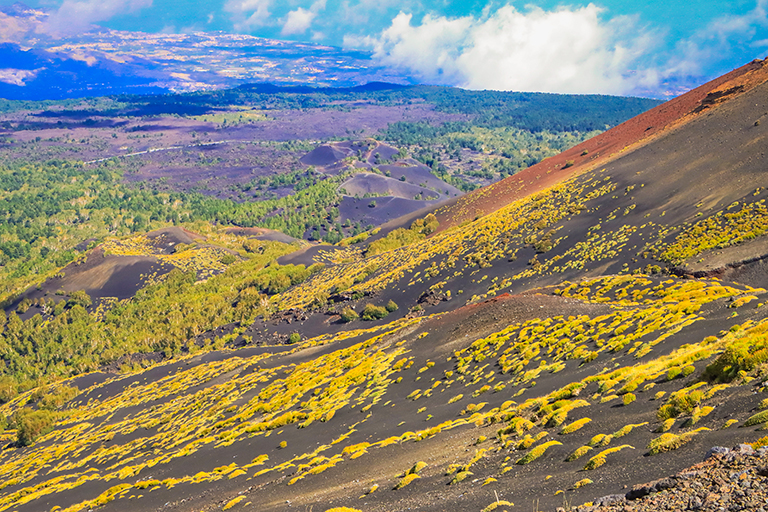
Among all that darkness, yellow broom flowers appear. I’d seen them so many times in photographs and always imagined them soft and delicate. But they’re tough, resilient. How could they be otherwise? They have to withstand wind, fog, sun, heat and whatever else this mountain decides to throw at them.
I picked up a surprisingly light piece of volcanic rock and discovered dozens of tiny red ladybugs hiding underneath. A beautiful splash of red against the endless black lava. Life in the most unexpected place.
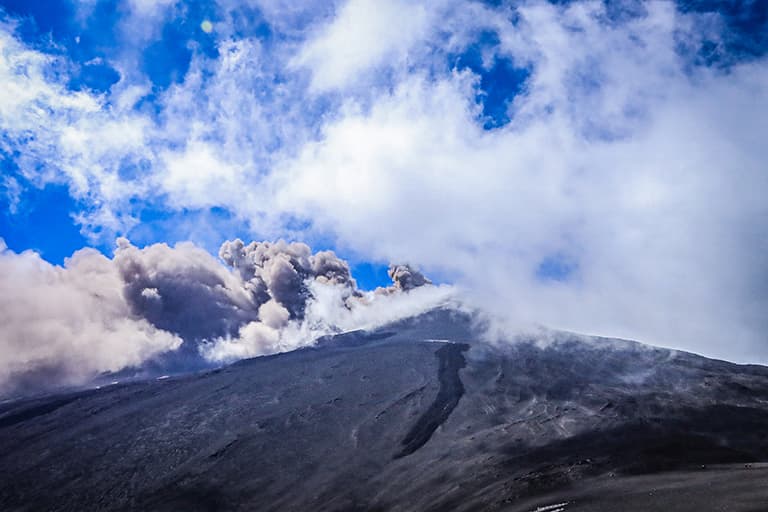
Black, Black and More Black
This time, perhaps for the first time, we had incredible visibility. We had climbed from Piano Provenzana to around 2,800 metres, our starting point for the descent. A pretty tough climb. Everything changed in an instant.
Black, black and more black.
Ahead of us stretched an immense landscape, almost nothingness. Somewhere down there, not so far away, were villages, roads, houses, people. Everyday life. But up here, for a moment, you lose every point of reference. There’s nothing to lean on. Your bike seems to have a mind of its own. You can’t even move too far sideways because you sink into the sand. You search for a line, something solid, something familiar. All around you, there’s this endless space.
As you begin descending the northern slopes, the volcanic sand is sharp, the broom flowers appear, the landscape keeps changing. Suddenly you can see for miles. A feeling takes over that is almost impossible to describe.
Pure freedom.
You breathe. It’s just you. You feel like you own the world, while knowing that you own absolutely nothing. Because the mountain is the one making the rules.
The Forest Has Its Own Silence
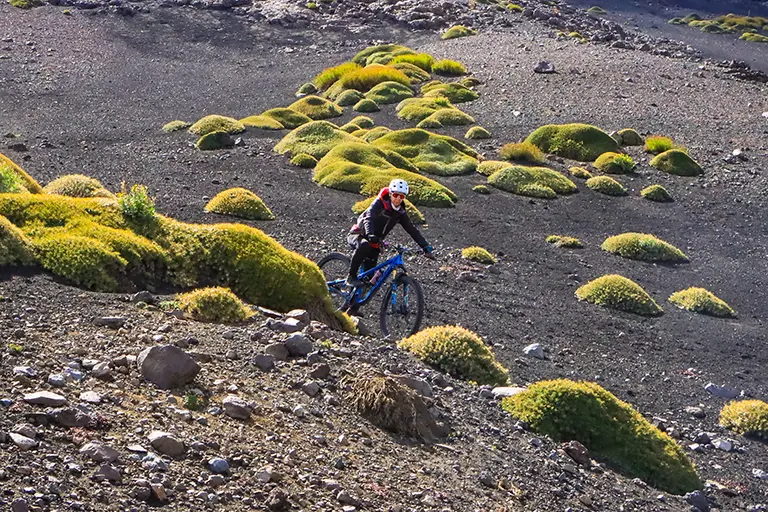
After trying to work out where the trail was supposed to go, assuming there was still a trail at all, we entered a forest.
Trees, white birches, volcanic sand.The black and white markings on the birch trunks look almost like eyes watching you as you pass.
For a moment, you feel strangely uncomfortable. Because this is their silence. Their world. You’re only a guest.
I think there’s a huge difference between crossing a place to conquer it and crossing it to understand it. You have to know how to enter certain places. With care, curiosity and, above all, respect.
Life Beneath the Volcano
Our journey didn’t end in the forest. Our base was Linguaglossa, a village at the foot of Etna, with low houses, dark stone and cobbled streets. Here, it feels as though everything has been shaped by the mountain itself.
During the day, the streets are busy. People talk, life moves around you. In the evening, the warm glow of old-fashioned street lamps lights up the dark facades, transforming the village. The noise gives way to silence.
This, too, is Mt.Etna.
To reach Linguaglossa, we’d followed a trail that barely existed anymore. What amazed me was the ground beneath our wheels. Not dirt, not the kind of rock we’re used to riding, but solidified lava, marked by long, straight lines. It looked as though the lava had somehow kept the memory of its own movement. I wonder which eruption it came from. How many years had passed since that glowing, molten rock had finally stopped flowing?
There we were, searching for a trail across something the mountain had created long before we arrived.
During those days, we also got to know Alessio, our local friend, a little better. He helped us, showed us around and shared stories about the trails and his work. I love listening to him talk about his adventures and the mountain biking scene that’s growing here.
There’s something wonderfully spontaneous about the way he tells his stories. Maybe because the bike scene here hasn’t yet been shaped by some of the more artificial dynamics we’ve come to know elsewhere.
When Alessio meets someone local, he starts speaking Sicilian, and suddenly we’re listening to a completely different language. The sounds, the rhythm, the words. At times, it almost sounds like Arabic.
There’s something fascinating about it. Sicilian has its own identity, shaped by centuries of history and different cultures. Listening to Alessio speak with the locals makes you realise just how much of Sicily’s history is still alive in its language.
Another little reminder that travelling isn’t just about discovering new places, but also about discovering the people who belong to them.
When Etna Changes the Plans
Etna wasn’t finished with us yet.
One day, the volcano decided to throw a little ash into the sky. Perhaps Hephaestus was busy working on another masterpiece in his workshop.
The result? Our flight was cancelled. When could we leave? Nobody knew. After leaving Catania and its energetic atmosphere behind, we headed towards Giarre, rented a car and went back up Etna.
One more ride.
But this time, everything was different. Two days earlier, we’d had incredible visibility. Now we were completely surrounded by fog. I wouldn’t say I was scared. But being on that mountain and not being able to see anything, absolutely anything, is a feeling you don’t easily forget. We’d been there just two days before. The trail was right there. Yet we couldn’t see a thing.
The landscape had disappeared.
All that remained was instinct, experience, that feeling you develop after years on a bike. The way you read the ground, sense movement, trust yourself. That passion for riding that burns somewhere deep inside you. But also the awareness that you have to listen to the mountain. Because you’re not the one in control.
Etna Is Sicily
Etna is a journey. Of course, you go there because you want to ride on a volcano. Because you think, Oh my God, how cool is that?
The riding is there. Absolutely.
The effort, the adrenaline, the excitement of discovering something new. The wind, the fire, the sand, the fog. Every element of nature seems to be at its most powerful.
There are trails, mountain refuges, Etna’s protected landscapes and descents unlike anything you’ve ridden before.
But that’s not all you take home. Because Etna is Sicily.
It’s a place where people still speak in the distant past tense, and somehow it feels as though the future doesn’t exist because everything is happening right now. It’s where you could eat arancini and cannoli from morning until night. Where people still address you formally, with that old-fashioned courtesy.
At first, you think everything is chaos, because you’re in southern Italy. Then you realise that everything actually follows its own very precise order. Maybe not the one you’re used to, but an order nonetheless. It’s the people you meet, the stories you hear, the words you don’t understand.
It’s the black lava you recognise again in the streets of a village. A yellow broom flower standing against the wind. A forest watching you in silence.
It’s a volcano that gives you a day of sunshine and, two days later, hides everything behind the fog. You come for the riding, but leave with something much greater than the memory of a mountain. Maybe that’s what travelling by bike is really about. Taking the time to discover a place, to feel it, and to understand a little more of what makes it special.